
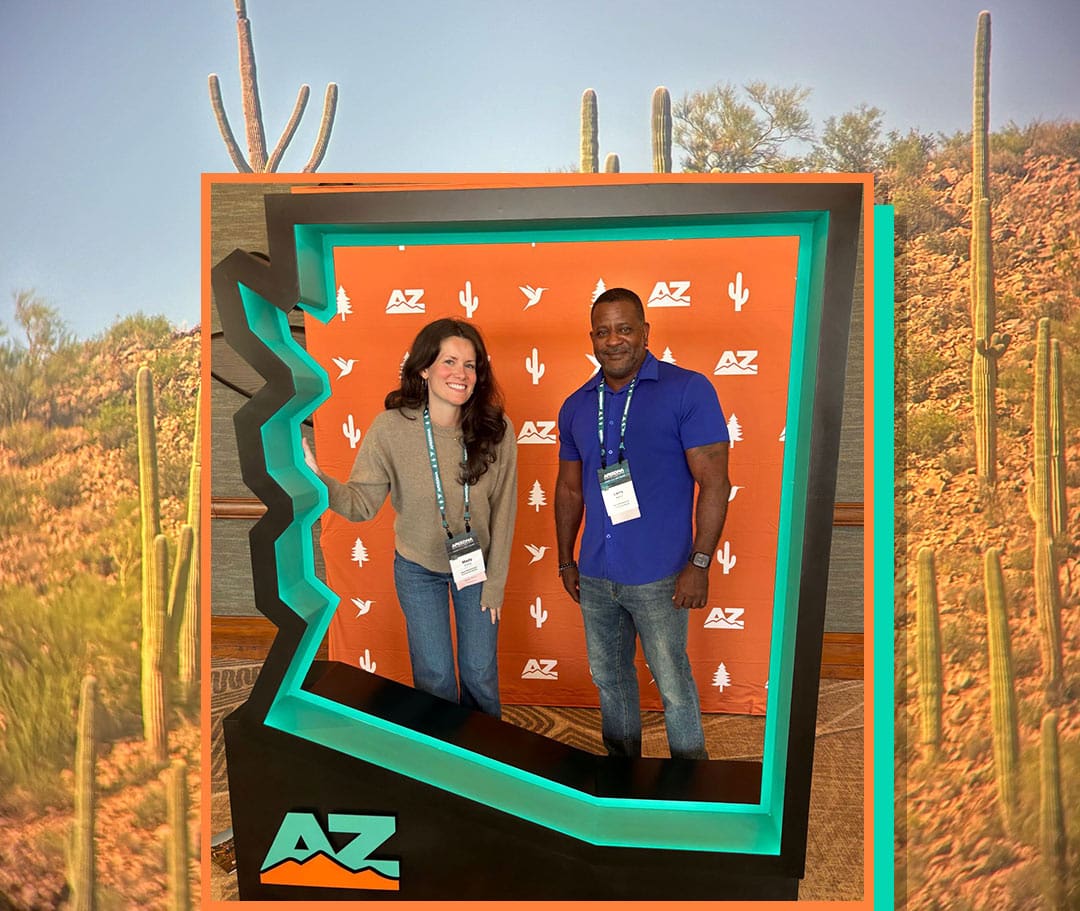
What We Brought Back from Tucson
Stargazing, AI Copycats, and a New Way to Fund Tourism
Every conference promises big ideas. The Arizona Governor’s Conference on Tourism in Tucson delivered, and we came home with three sessions worth building a whole strategy around.
Here’s the rundown.
01. Dark Skies Are the Next Great Untapped Amenity
Here’s a stat that should stop every DMO scrolling: 80% of Americans are unable to see the Milky Way. Not a photo of it. The real thing, close enough that it feels like you could touch it.
That gap is the whole opportunity behind dark sky tourism, and Arizona is already building around it. Think observatories and planetariums paired with kids’ workshops, star parties where grad students set up telescopes and explain what you’re looking at, and full moon “moonrise” events that sell out campgrounds. Some dark sky resorts and RV parks are pursuing official dark sky designation as a standalone amenity, the same way a hotel might market a rooftop pool.
There’s a real substance story here too, not just a pretty one. Exposure to bright artificial light at night is repeatedly linked to negative health effects, and light pollution disrupts nocturnal wildlife. Positioning dark sky programming as a wellness and conservation play, not just a photo op, gives it staying power with both media and funders.
Our takeaway for clients: if your destination has any rural or low-light-pollution geography, dark sky tourism is low-cost, high-story-value programming. Pair it with a local university’s astronomy department or a certified Dark Sky Coalition contact, and you have a partnership-driven content series that writes itself, star party after star party.
*Shoutout to panelists Cindy Aguilar, Vice President of Communications, Visit Tucson; Mike Weasner, Dark Skies Expert; Kevin Schindler, Historian and Public Information Officer, Lowell Observatory; Richard Rummler, Park Ranger at Kartchner Caverns State Park.
02. Your Basic “Digital Doppelgänger” Might Be Writing Your Competitor’s Content Too
This one was the most unsettling session of the conference, in the best way. Speaker Andrew Davis laid out what he called “algorithmic convergence.” As more destinations lean on the same AI tools to write the same style of content, everything starts sounding the same. And sameness isn’t just boring; it’s disposable.
The fix isn’t avoiding AI. It’s using it deliberately, as a trained collaborator that mirrors your specific style, knowledge, taste, and perspective, rather than a generic voice that could belong to any destination in the country. Davis’s framing: when you preserve your originality, you preserve your value.
For DMOs, that’s a direct challenge. If your content sounds like it could run under any destination’s logo, it’s not doing its job. The opportunity is building what’s essentially a documented brand voice, the specific phrases, rules, and personality that make your destination’s content unmistakably yours, and then holding every piece of content (AI-assisted or not) to that standard.
Our takeaway for clients: this is exactly why brand voice guides aren’t a “nice to have” anymore. They’re the thing standing between your destination and sounding like everyone else’s.
03. Tourism Improvement Areas Are Quietly Becoming a Real Funding Tool
The most consequential session for anyone thinking about budget was the breakout on Tourism Improvement Areas, or TIAs. Under Arizona’s HB 2950, cities can opt into a self-assessment model where hotels collect a small additional fee that funds destination marketing, and both the governing board and spending plan have to be public.
Visit Phoenix walked through their rollout timeline: present to the city, get public hearing approval, set up collection with the Department of Revenue, hotels begin collecting assessments, and then funds start flowing to the DMO.
The number that got the room’s attention: in Texas, eight cities running TIAs now generate more than $65 million a year combined for destination marketing and sales.
Our takeaway for clients: if your city hasn’t looked at a TIA model, now is the time to start the conversation, especially with more states following Arizona’s lead. We can help build the case, the timeline, and the public-facing materials a city council will actually want to approve.
Curious how any of this applies to your destination or brand? Reach out to your Aqua team and let’s talk through what a dark sky partnership, a real brand voice, or a TIA feasibility conversation could look like for you.
If you are an Arizona-based Destination Marketing Organization or business, great news! Aqua is an approved vendor for the state. To inquire about working together, please contact info@welcometoaqua.com.